Globally Distributed Autonomous AI Database
Oracle Globally Distributed Autonomous AI Database is a fully automated distributed cloud database that helps customers meet data residency requirements, provide survivability for business-critical applications, and deliver cloud-scale database performance.

Support a global user base with a fully automated distributed database
1
Address data residency requirements by controlling where data resides.
2
Provide high availability by distributing shards across OCI availability domains and regions.
3
Enable cloud scale and performance by automatically scaling the number of shards and their individual performance.
4
Develop distributed database applications and efficiently manage them as a single logical database with no changes required.
5
Automatically distribute and redistribute data based on performance needs and location.
6
Use Oracle Autonomous AI Database Select AI to query distributed data using natural language without knowing where it is or how it’s structured.
How it works
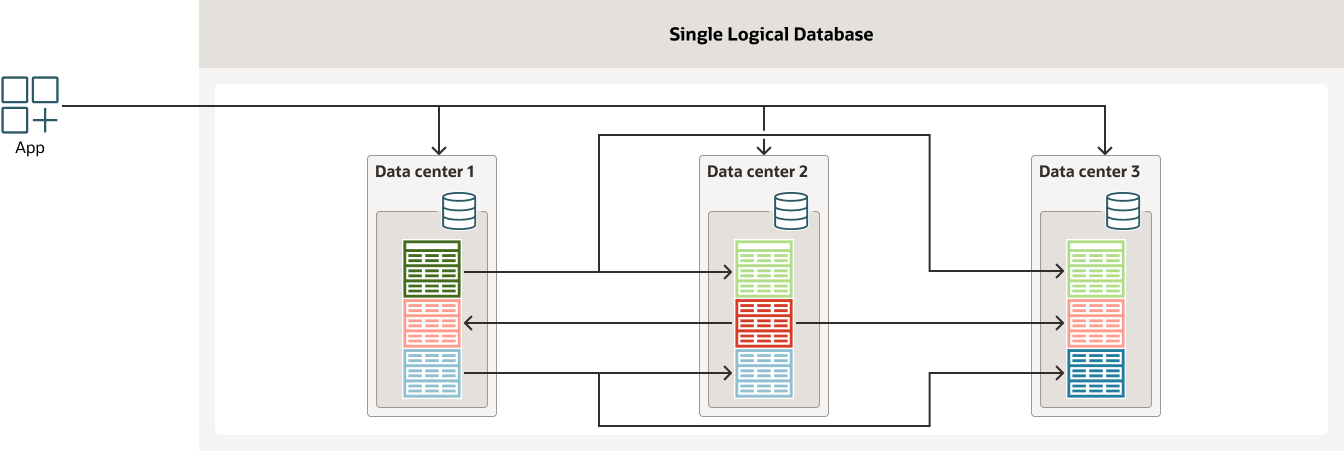
Globally Distributed Autonomous AI Database is a single logical Oracle AI Database that is distributed as a set of Oracle AI Database shards. Each shard is an independent Oracle AI Database instance that hosts a subset of the logical database's data. Multiple shards can run in one OCI availability domain to maximize performance, in multiple OCI availability domains or regions to provide the highest possible availability, and in OCI regions across different geographies to help meet data residency requirements. A common shard catalog supports automated shard deployment, centralized management of a sharded database, and multi-shard queries using the automated query coordinator. Shard directors enable high performance connection routing over networks to access data in a distributed database. A client application request is routed directly to a shard using the Oracle drivers and provides a sharding key with the request.
Globally Distributed Autonomous AI Database in the media

Oracle Launches Globally Distributed Autonomous AI Database

Oracle’s Autonomous AI Database Goes Distributed and Global

Meeting the new reality for data sovereignty
Globally Distributed Autonomous AI Database use cases
1
Address data residency requirements for distributed data warehousing and data lakes
Combine user control of data distribution policies and built-in automation to keep the storage and processing of growing data sets in required geographical locations while providing centralized administration.
2
Cloud-scale transaction processing
Improve customer experiences by enabling the database performance needed by cloud-scale applications and locating data close to distributed users—all with automated data distribution and management.
3
Maximum availability for mission-critical applications
Run applications that require extremely high availability using Globally Distributed Autonomous AI Database’s shared-nothing architecture and fault-tolerant local Oracle Exadata Cloud Infrastructure.
4
Distributed data pipelines and analytics
Rapidly load, process, and analyze massive data sets in a distributed cloud while addressing data residency requirements. Get unified insights with massively parallel processing across many compute instances.
5
Query global distributed data using natural language
Easily gain insights from your data without knowing where it’s located or how it’s structured. Simply ask questions in natural language and let Oracle Autonomous AI Database Select AI build your queries and present results.
6
Build cloud native, scalable mission-critical applications
Build scalable, secure, distributed applications using multiple data types and models across a single logical database without the need for additional code or skills.
See what top industry analysts say about Globally Distributed Autonomous AI Database
![IDC Logo]()
“Oracle’s approach to sharding [makes] application interaction with databases transparent and reliable…[Its] data distribution models, replication methods, and shard deployment options…enable Oracle AI Database to meet unique customer requirements.”
Carl Olofson Research Vice President, Data Management Software, IDC
![Kuppingercore logo]()
“Data sovereignty…can only be efficiently addressed with a universal distributed database with sophisticated sharding capabilities. Oracle was able to deliver a full-featured distributed relational database because of its decades-long expertise.”
Alexei Balaganski
CTO and Lead Analyst, KuppingerCole Analysts![MOOR Logo]()
“This industry-first combination of autonomous database management and centralized data regulation adherence should be a significant cost and time saver for IT organizations.”
Matt Kimball Vice President and Principal Analyst, Data Center, Moor Insights & Strategy
![DB Insight logo]()
“Oracle Globally Distributed Autonomous AI Database uses sharding to enable enterprises to manage data globally but literally act locally. And it does so with the benefits of a database that runs itself.”
Tony Baer
Principal, dbInsight




Globally Distributed Autonomous AI Database resources
- Announcements and blog posts
- Achieve Data Residency, Availability, and Scale with Oracle Globally Distributed Autonomous AI Database
- Leading Industry Analyst Perspectives on Oracle Globally Distributed Autonomous AI Database
- The Future of App Development Using New AI Innovations in Autonomous AI Database
- Announcing Select AI with Retrieval-Augmented Generation (RAG) on Autonomous Database
- Resources
- Documentation
- Oracle Sharding LiveLabs
- Learn how to use Oracle Sharding for mission-critical, internet-scale apps
- Hyperscaling data management platform with petabytes of data (43:48)
- Meeting data residency requirements with a globally distributed database (PDF)
- Analyst Report: Meeting the new reality for data sovereignty by dbInsight (PDF)
Get started with Globally Distributed Autonomous AI Database
Try Autonomous AI Database for free
Explore with $300 in free credits and Always Free instances of Autonomous AI Database.
Attend an event
Attend webcasts or live hands-on weekly workshops conducted by our product experts.
Contact us
Interested in learning more? Contact one of our experts.